By Sandy Rowan
Universal Romance is the spark that ignites and takes away all of the oxygen in a room. It can be upended by fate and time, but it ALWAYS stays in the heart.
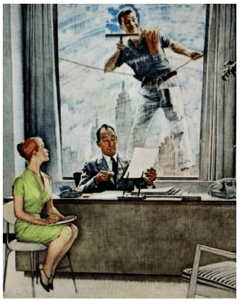
Once Upon a Time. . . The Mystery

A beautiful maiden dressed in green,
Sat by the window but would not be seen.
The window was magic, and others could look,
This story starts now in this fairy-tale book.

A lad through the window looked on in vain,
The girl’s beauty was legend; he’d never be the same.
He smiled and he winked as if she were there,
With the green dress on, sitting in her chair.

The Magical Window, was it lost in time?
Now those who looked through it are part of this rhyme.
Will the lad and the lady meet decades later?
The story gets better and even much greater.
CHAPTER ONE
The Dog Walk
November 9, 2024, was a crisp sunny day, perfect for a football game happening 165 miles away. By happenstance, a fortuitous moment became a game changer for me just two blocks away in my very own neighborhood—suddenly, I was the significant twist in a story that started sixty-five years ago.
My husband and I had spent the chilly day running around town doing errands and were anxious to get home and watch the kick-off of the University of Oregon’s home football game against the Terps (Go Ducks!). The game would air at four p.m. so we wanted to make sure to get any other tasks done as well as a pre-game dog walk with our senior labradoodle, Halia. Her body clock is always set for a four p.m. walk and if we didn’t take her soon, she would pester us the whole game (#1 Universal Doggy Law*). We wanted NO interruptions once the coin-toss started the game, so off we went with Halia in tow at a brisker pace than usual.
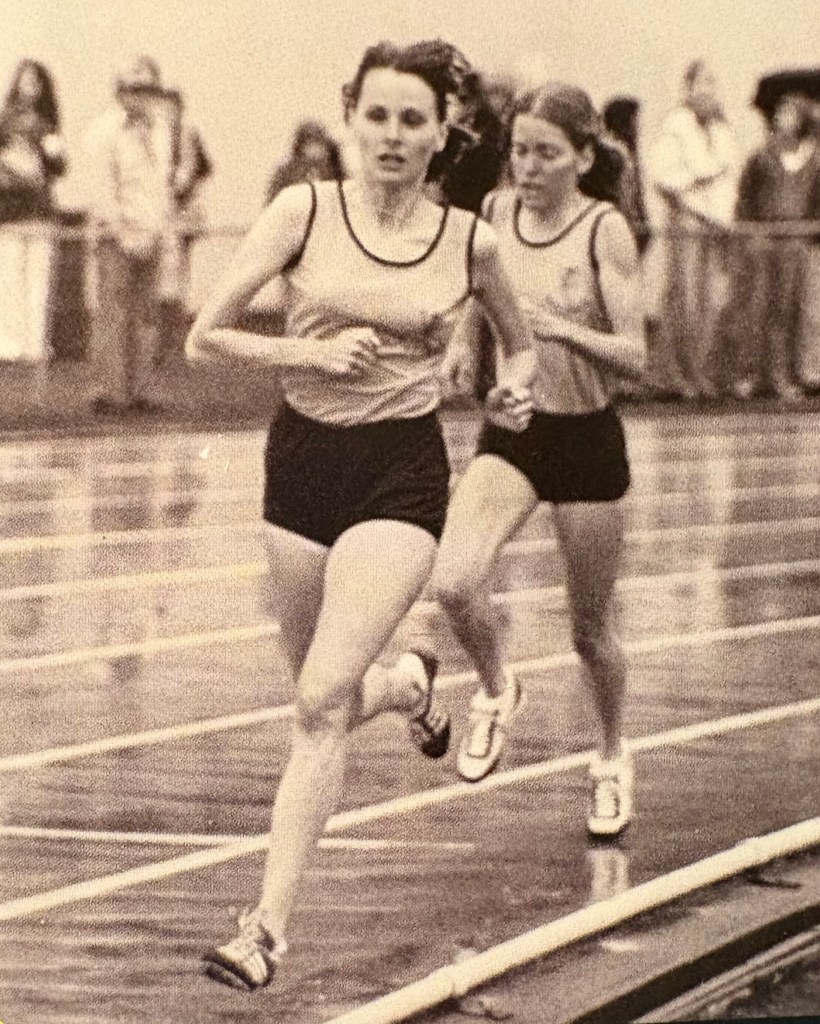
Now don’t get too excited—Halia settled into her usual pace, but to save time, we didn’t let her sniff all her usual favorite spots (#2 Universal Doggy Law*). I even wore my forty-seven-year-old letterman’s jacket that I earned as a distance runner at U of O (me bragging) back in the ’70s. It was only the second time in my life I had ever worn that jacket—I thought wearing it might just give the Ducks a little bit of good karma. Besides, I am pretty damn proud of that jacket, even though I must admit I had the weirdest running style.
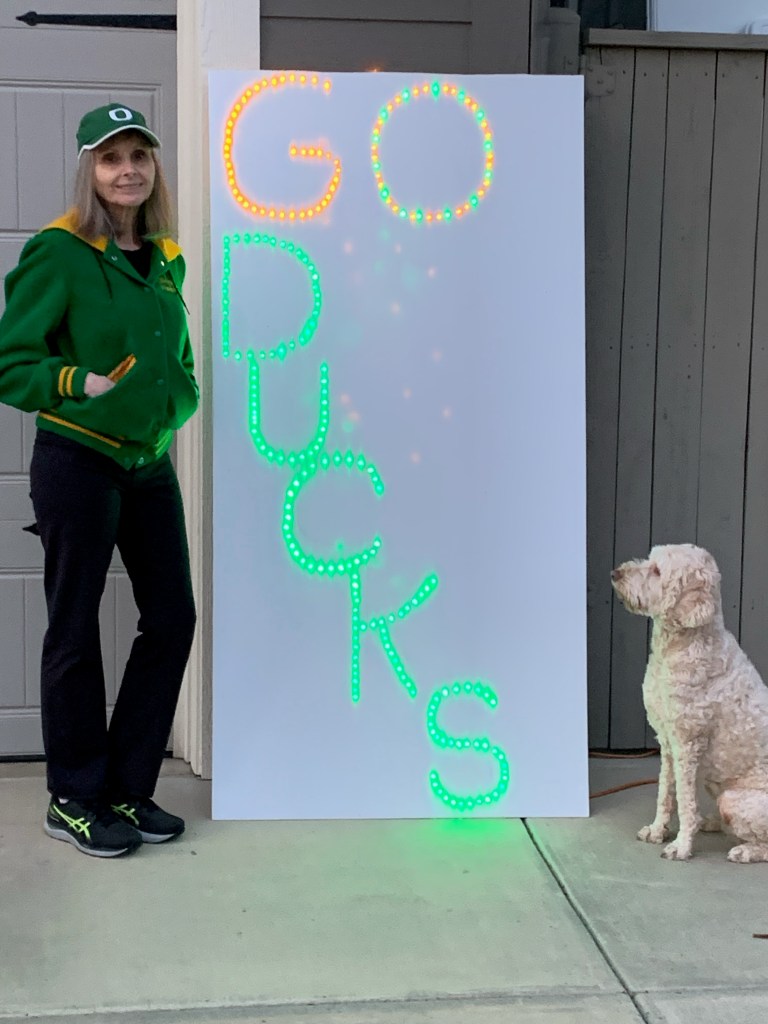
We were anxious to get back from the dog walk, and we looked forward to snacking on the famous Harry and David’s pepper and onion dip that was chilling in the fridge, waiting to be paired with the giant bowl of potato chips on the counter. The decision had already been made—we would throw caution to the wind and just give sodium the middle finger that day. On the way out the door, we flipped on the garage switch to light up the custom six-foot sign I made, which was proudly positioned and standing tall in the driveway. It read “GO DUCKS” and was magnificent! It was early, but you could already see the glow of the green and yellow Christmas lights shining brightly in the fading light of day (yellow LED lights are HARD to find). The game was taping, just in case . . . thanks, DVR!
*#1 Universal Doggy Law—Dogs will pester any human and manipulate them for whatever that dog wants and until the human gives in.

*#2 Universal Doggy Law—Dogs sniff gross stuff, including any type of poop (and sometimes dogs even EAT the poop du jour).
CHAPTER TWO
The Claim to Fame
Halia’s green collar jangled as we slipped it over her head, snapped the buckle, and headed out the door for the speedy walk. We were on a mission and every minute counted. Turning the corner, we saw a small but spry elderly lady approaching her mailbox. As we got closer, she called out to us from across the street. “Hi there—may I pet your dog?” Bill and I obliged and crossed the street with treats in hand so Halia would gracefully sit for this new stranger.
The lady was excited to meet Halia, who reminded her of Precious, her sixty-five-pound labradoodle that was apparently a bigger version of Halia and could have been her twin. Precious had recently been diagnosed with cancer, but because the lady’s husband had passed away the year before, the dog was just too big for the diminutive lady to take care of anymore. It was a toss-up as to whether the dog or the lady was bigger than the other. The hard decision had to be made and Precious was sent to live out her days at a ranch for dogs waiting to go over the Rainbow Bridge. Halia sat patiently and was smitten with her new friend, her tail wagging and sweeping the sidewalk better than any Roomba could ever do.
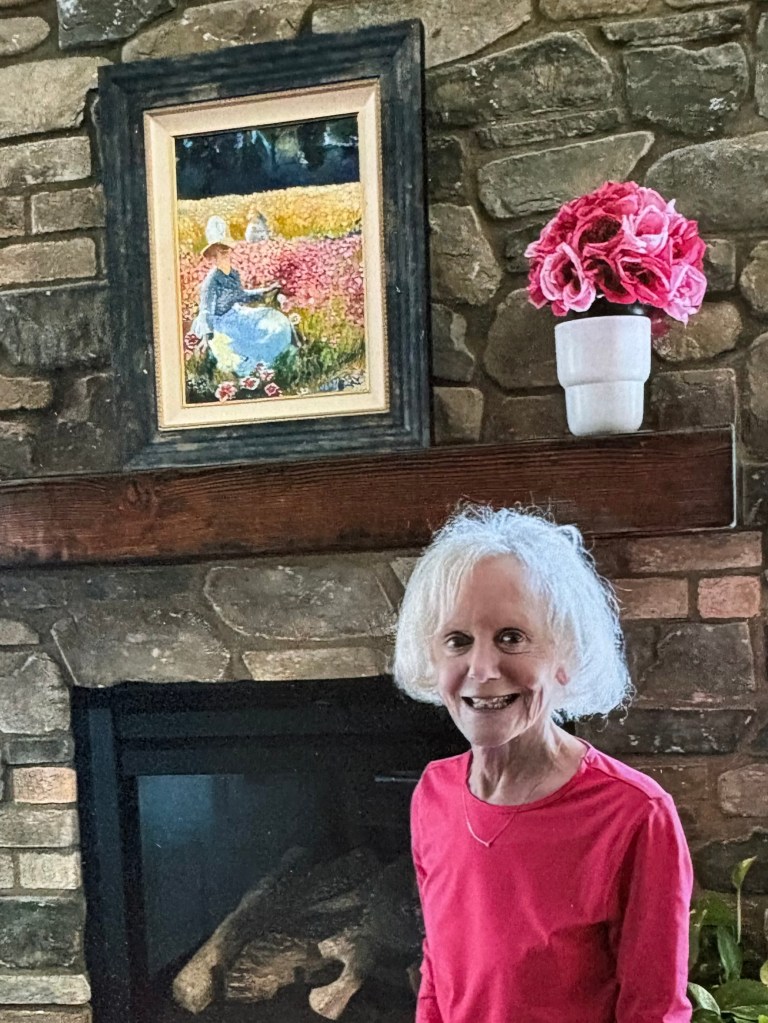
The lady looked at me and said, “You look like you’re athletic and must be in good shape?” I kindly told her I don’t run anymore, but I bragged (again) about my varsity letters that I had earned at U of O during the forefront of Title IX for women’s athletics. I chuckled as I mentioned my famous story of when I ran in a 5k race nine months pregnant—and won. My son was born on his due date the next day and is now forty-two years old. Oh, and I also won a two-mile race ten days after he was born! The lady was impressed, then she demurely said that she also had a “claim to fame” and asked me if I would like to come into her house to see what makes her so famous. I was intrigued and said, “Of course, I’d love to!” My mom had passed away around the same time as the husband of this lovely woman, so her energy and kindness were just the ticket to lift my spirits on that beautiful “ORYGUN” day. It was clear our mission was altered, but I gladly sent Bill and Halia on their way—I could feel something magical was about to happen.
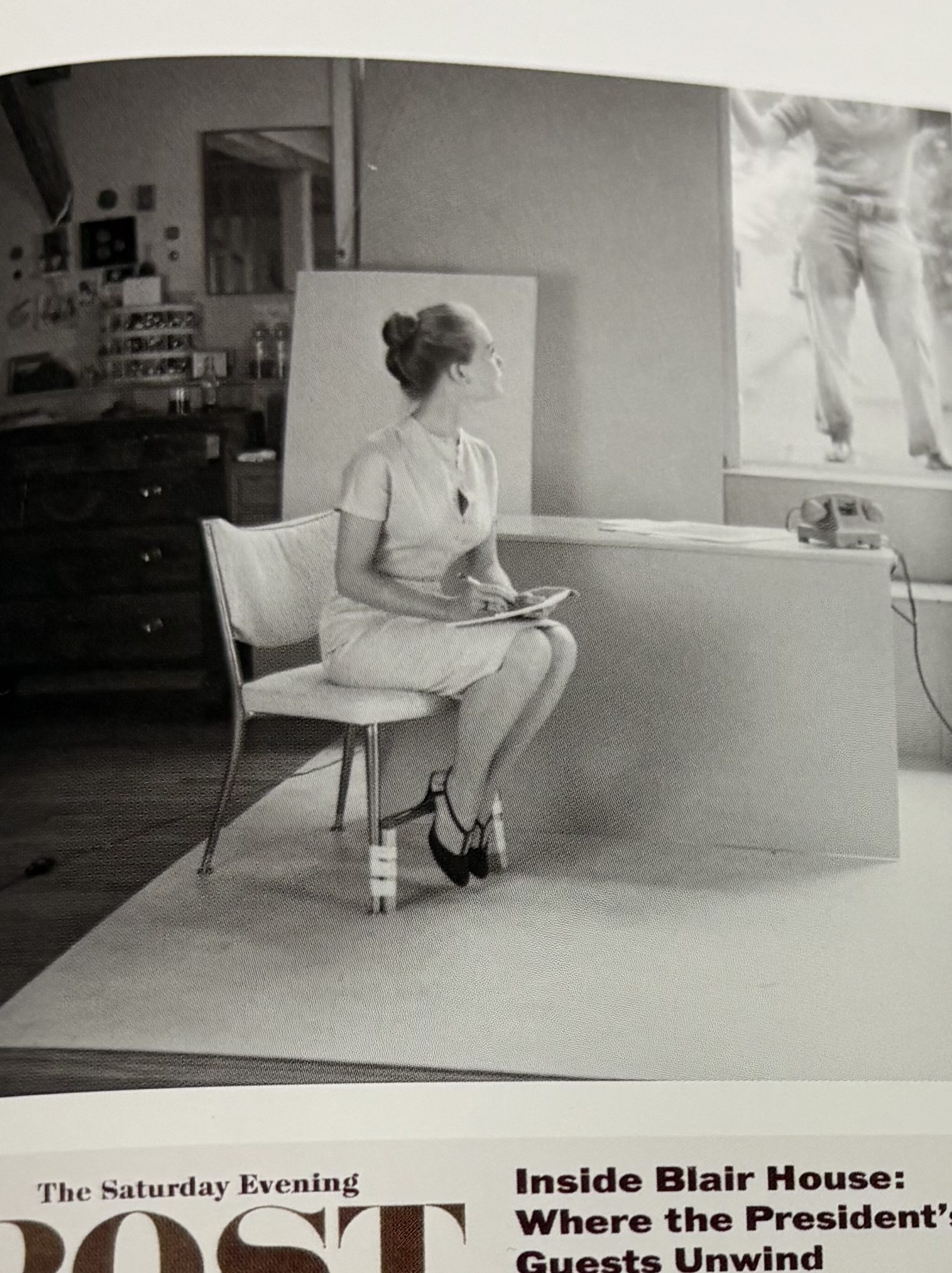
After Nan introduced herself, I followed this very petite eighty-five-year-old woman into her house as she led me to her living room. Hanging on the wall were two large framed prints of Norman Rockwell’s paintings, The Window Washer and University Club. Nan pointed to the seated secretary in the Window Washer print, who was wearing a green dress and strappy heels, and next pointed to the gal in the red dress in the other print. She smiled at me and said, “That’s me.” My jaw dropped to the ground, and I finally got the words out to say, “Who are you, Nan?!” She then began to unravel the mystery of Rockwell’s paintings.
*If by chance you haven’t already done so, your HOMEWORK is to Google Rockwell’s The Window Washer and University Club paintings
. . .
Go ahead—take your time.
CHAPTER THREE
The Secretary
Nan was twenty years old in 1960 when she posed for Rockwell’s paintings, which soon became Saturday Evening Post covers. Nan had always been athletic and quite the swimmer. She always pulled her hair back in a bouncy ponytail, mostly for convenience and not for looks. For The Window Washer, Rockwell decided to have his daughter-in-law, Gail, fix Nan’s hair so it would look how he wanted it for the photo session—up and coiffed in a French bun. It was clear, Rockwell had a vision of what Nan should look like as a “fluffy secretary.” (Whatever THAT meant!) Norman was always VERY particular and knew precisely what he wanted.
Next, Rockwell sent Nan on an errand downtown to England Brothers Department Store and told her to bring back all the dresses in her size. This way, Norman could pick out what he thought would best represent his concept of the “fluffy secretary” for the painting. Nan must’ve felt like Julia Roberts in Pretty Woman! Luckily, selecting dresses for Rockwell was an easy task at the familiar store where everybody knew Nan, especially since her father was part owner of the department store and a furrier on the fifth floor.
When Nan brought an armload of dresses back to the studio, Rockwell didn’t like any of the choices. Instead, she ended up wearing her own green dress and shoes from her closet at home for the model sitting. In the final painting, Rockwell lowered the neckline of the dress and added straps to her shoes, as well as a bar across the bottom of her chair. Adding the bar would make it appear as if the secretary’s knees were being held up and her feet perched on a bar that never actually existed. To this day, Nan is quite proud of her athleticism and the fact that, even though there was no actual bar for her to place her feet on, her abs of steel held her knees up just fine! After all, Nan had been a gymnast, cheerleader, and infamous water skier who would drop both skis in the process of climbing up the legs and backside of Felix, a high school classmate, and end up sitting on his shoulders—the pair were quite the entertainment as they tootled around the lake. She was NO fluffy secretary!
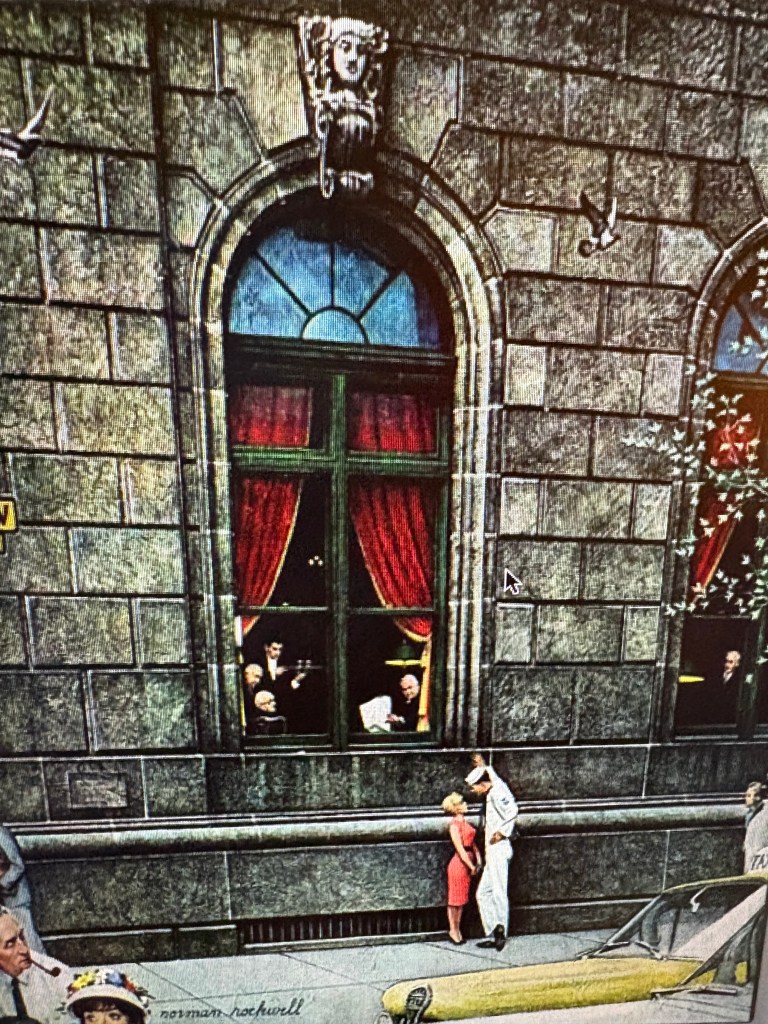
In the University Club painting, the other soon-to-be Post cover, Nan depicts a young woman who is about to be kissed by a tall sailor. A bunch of old men “lookie-loos” watch them from a window, not knowing if it was a reunion or a farewell for the pair. If you look closely, you can see Norman Rockwell in the lower left corner of the painting with his daughter-in-law, Gail. Rockwell used one of his rotating photographers as the tall sailor in the painting. He apparently “fit the bill” for what Rockwell envisioned and needed on that day. (Norman would sometimes use his photographers for fill-in models.)
College was on the horizon for Nan. Her mother hoped she would attend the University of Massachusetts Amherst with its lower cost than Boston College, where Nan wanted to study. This new job with Rockwell might help facilitate her future college plans. When Nan first met Rockwell, he approved of her as the model for The Window Washer, but it was a little unclear when he asked her, “Is $25 OK?” She was a bit confused and had no idea who was giving and who was not? She thought to herself, “Am I supposed to pay him?” Nan was thrilled it was the other way around! In the end, Rockwell paid Nan $25 an hour, earning her a grand total of $268.30. Between all the graduation gifts from family and friends, as well as the city and school scholarships, she now had more than enough to pay tuition for her freshman year at Boston College. There she got to see the tall gray stone buildings and the Gasson Bell Tower soaring high into the campus skyline that she had always dreamt of. Nan, eager to learn, knew this university was where she belonged.
Nan grew up in Dalton, Massachusetts, a transition town between the rural and urban portions of Berkshire County. Dalton’s quaint beauty and diverse population of people provided an idyllic wonderland where lifelong friends were made and neighbors took care of each other. It seemed to truly mimic a Norman Rockwell painting.
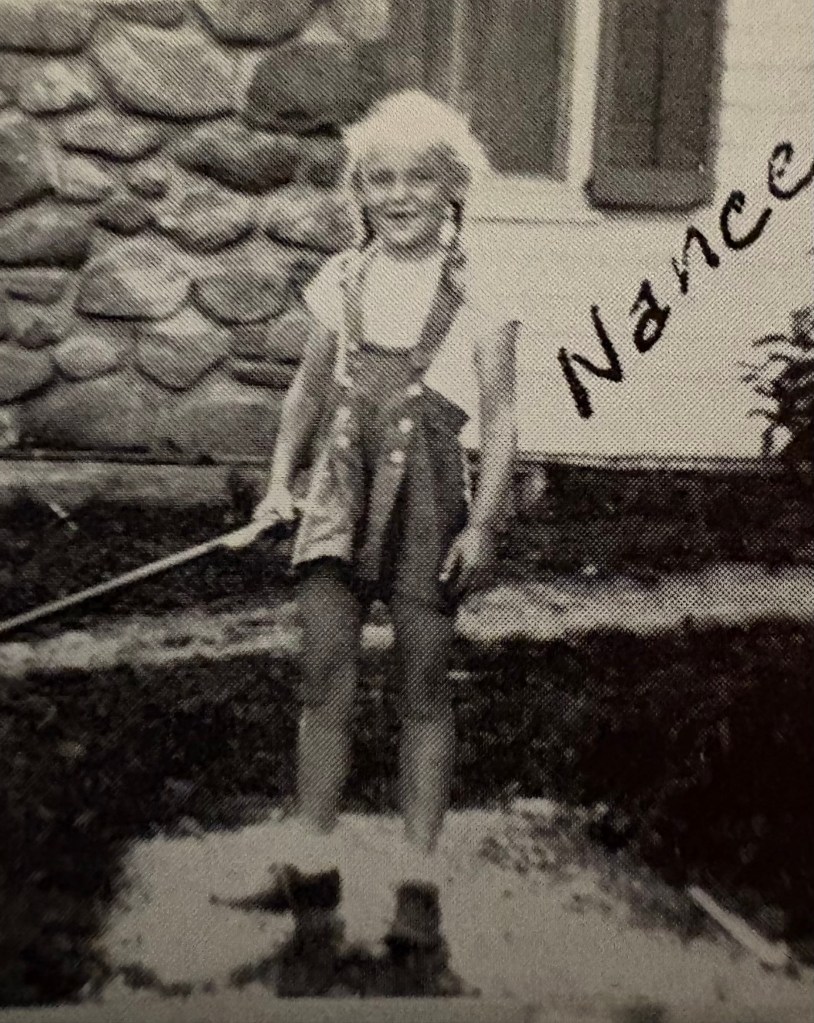
Even before Nan, or Bitsy as she was often called, was five years old, she had an adventurous soul. She would sneak out of her house, with her blonde braids trailing behind her, and scramble up the old stone chimney to perch atop the warm slate tile roof, separated from all those who would dare to come and get her. Bitsy would lean back and tilt her head up to catch the sun’s rays and listen to the peaceful murmuring brooks and mooing cows, while the sound of old-fashioned car horns intermittently pierced the air. From atop her special throne, she could survey the panorama of the Berkshires’ rolling hills and farmland. Far off in the distance, clear blue lakes, waterfalls, and mountains awaited this spirited girl with new adventures for another day. As usual, Nan’s mother would break the tranquility of the moment after she discovered the escapee and call up to her from below. “Bitsy—get down from there right now!” And she would—at least until the next time.
One town over from where Nan grew up, Pittsfield’s senior class president and Nan’s future fiancé, Bob Walker, graduated from high school in 1958. Bob was a bright, athletic young man who made his mark as an impactful leader in the community. Due to his hard work and diligence in school, Bob accepted a commission to the U.S. Military Academy from Senator John F. Kennedy and Congressman John W. Hazelton. However, Bob’s sophomore year at West Point was interrupted by a training accident during maneuvers and many of the men were injured and some had died. Bob’s injuries left him medically disabled, resulting in an honorable discharge. A few years later, Bob and Nan attended his class’s graduation ceremony and honored the cadets he had trained with prior to his injury. Afterward, Bob and Nan would meet privately with the graduation guest speaker President Kennedy and his wife, First Lady Jackie Kennedy. It had been a number of years since Bob had interviewed with the then senator Kennedy for his appointment at West Point—the full circle of this poignant moment was unforgettable.
During this time, Bob and Nan were married in September of 1960, and after celebrating their honeymoon in Newport, Rhode Island, they returned to Chestnut Hill near Boston. Both studied at Boston College and then continued on to the University of Massachusetts Amherst. At this point in their lives, three lovely boys were born who never ceased to give their parents great joy. After attending UMass Amherst, Bob received his Master of Science in geology, and Nan later earned her Bachelor of Arts in English and French, as well as two minors in history and humanities from the University of Oklahoma.
The rich and fulfilling experiences throughout Nan’s life have given her a palpable joie de vivre that transcends those singular moments she portrayed as a young woman in Rockwell’s paintings. In the past, Nan worked for Judge Lawrence Edward Walsh (of Nixon fame) in the ’70s, wrote a book about Attila the Hun, and was a docent at the 2010 Smithsonian Institute Exhibition called “Telling Stories: Norman Rockwell from the Collections of George Lucas and Steven Spielberg.”
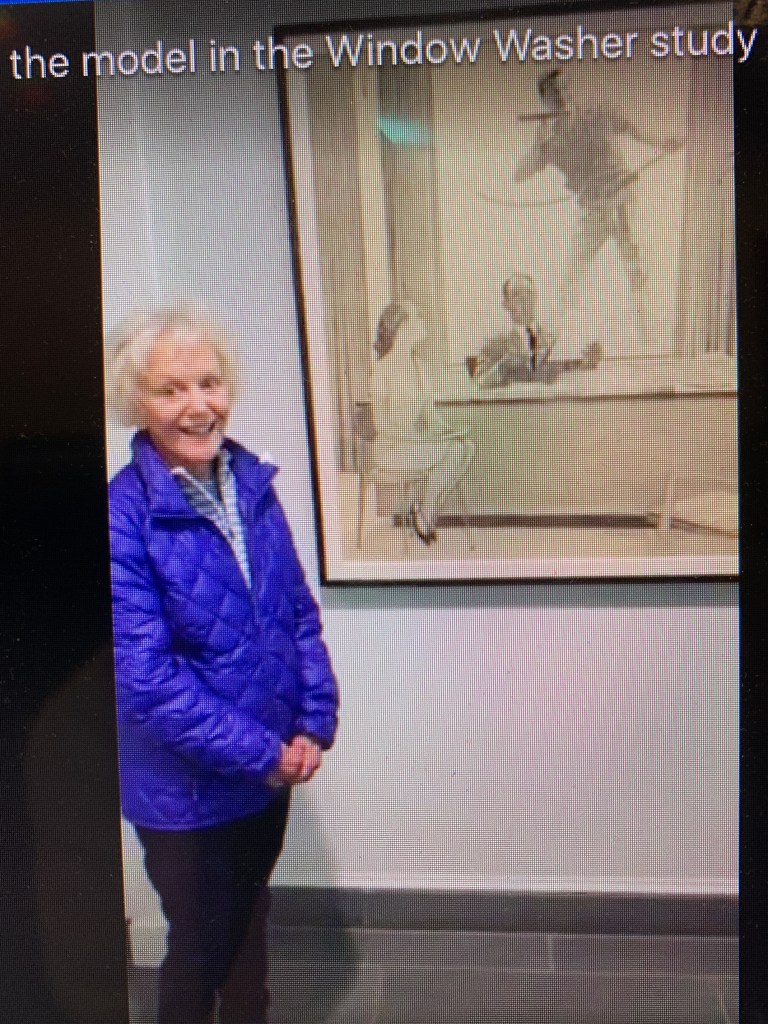
Nan’s invaluable knowledge made her the perfect storyteller and docent at the exhibition, especially because she was the actual young lady in the painting, The Window Washer. She truly loved standing by the painting and sharing narrative stories with museum guests and answering questions about her experience working with Rockwell. This exhibit displayed fifty-six of Norman Rockwell’s works that had been purchased by George Lucas and Steven Spielberg over time. Rockwell’s paintings have had a great effect on these two filmmakers throughout their years as young boys and later as storytellers. A Rockwell painting depicts a moment in time just as a film melds many single images together to make a movie. It’s clear that Norman Rockwell’s influence is woven into the fabric of their films and artistry.
CHAPTER FOUR
Beyond the Pane of Glass
Meeting Nan that very first day was like finding a perfectly wrapped present underneath the Christmas tree waiting to be opened. With the help of the infamous game-day dog walk and a little bragging on both my part and Nan’s, I was lucky to experience Rockwell’s paintings firsthand and through the eyes of a twenty-year-old Nan. When I realized she was the Secretary in The Window Washer, I knew something spectacular had just happened. I felt as if I were watching a favorite movie that reached deep into my soul.
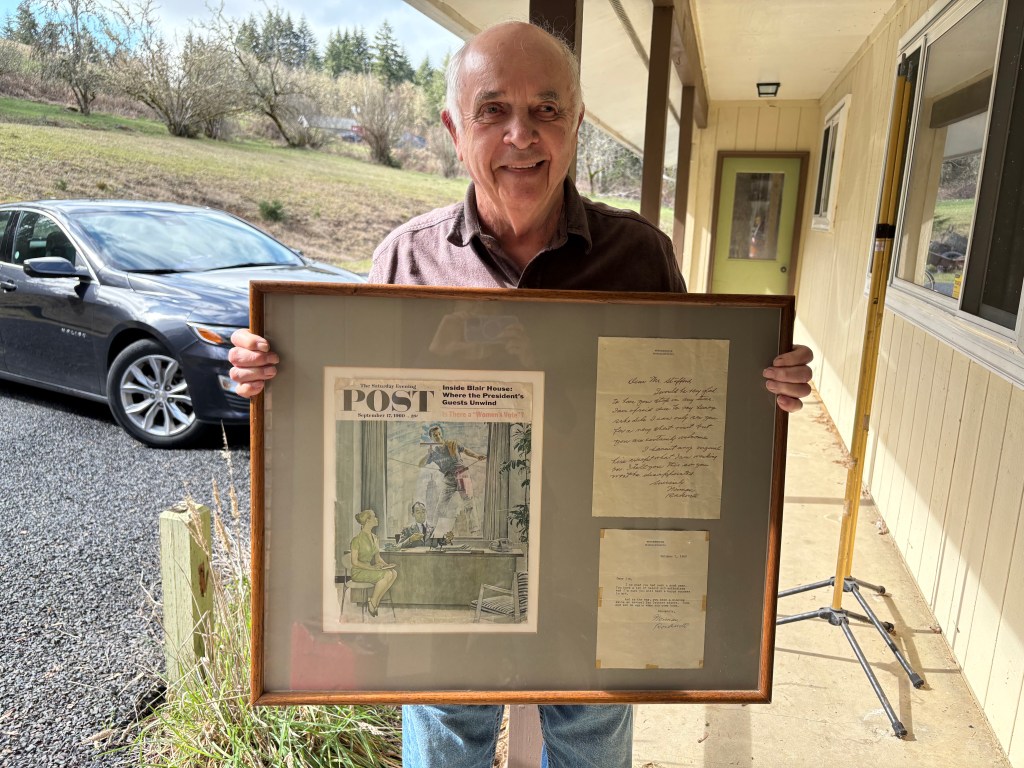
Now it was time to look beyond the pane of glass in the painting and find the Window Washer himself. A week later, after searching for the man on the ladder with the fabled flirtatious wink and trying to reach out to him, the phone rang. I heard a voice on the answering machine. “Hello—I got a message from Sandy. This is Jim.” I had never run that fast in my whole life as I ran to intercept that message. I picked up the phone.
I had become the significant twist in this fairy tale.
CHAPTER FIVE
500 Pieces of the Puzzle
“Stop the presses,” I say!! If you did your homework, you have realized that you, the reader, are now a part of this story, just like I am. You are one of the millions of spectators who have looked through the pane of glass that divides the Secretary and the Window Washer in the “Once Upon a Time” poem. As you parse the events of long ago and of today, the story will unfold. After all, the strokes of a paintbrush can only express a singular moment in time—an innocent youthful wink and a glance where eyes connect. But just like in a movie, something always happens before and after each scene. That’s what keeps the audience engaged as they feel it without even knowing it—just like you are right now.
Remember . . .
Universal Romance is the spark that ignites and takes away all of the oxygen in a room. It can be upended by fate and time, but it ALWAYS stays in the heart.
Air was about to fill the room again . . .
 Time caught up.
My heart pounded as I grabbed the phone. “I can’t believe I found you Jim!” Hearing the Window Washer’s voice was heartwarming as he said, “Me too! Thank you so much for taking the time to find me.” Jim and I talked for an hour that first time and the gaps between Nan’s and Jim’s stories narrowed, making more sense.
Who would’ve thought that both Nan and Jim have large prints of The Window Washer hanging in their homes. And for decades, unbeknownst to one another, they would sometimes wonder about each other. Jim expressed, “I couldn’t believe what I was hearing when I got your message. I bet Nan is still as cute as she was in that painting!” I wholeheartedly agreed and replied, “Absolutely!” Wistfully, and thinking of his own special time with Rockwell over sixty-five years ago, Jim quietly expressed, “I can’t believe this is happening—I must say it’s all like a magical storybook fairy-tale!” Again, I agreed.
I felt I was beginning to unwrap the present that I had found from under the Christmas tree, and it was a 500-piece puzzle that had all of the edges already locked into place. I eagerly anticipated filling in the rest of the puzzle—maybe, just maybe, the last piece will fit nicely.
Norman Rockwell had succinctly captured the perfect instance of The Wink in the painting that demonstrated the elation of the Window Washer, who was just doing his job in a high-rise widow and hoped to catch the eye of the Secretary. “Hmm,” I thought, and then I asked myself, “How did Jim, a country boy from the West Coast, and Nan, who grew up in the Berkshires on the East Coast, both end up in the same painting?” Interestingly, Rockwell would always use local people and friends or family members as models for his paintings. How did Jim, from Chehalis, Washington, become a part of Rockwell’s Americana?
I took a breath and air filled my lungs.
CHAPTER SIX
The Window Washer
Growing up as a young boy in the country, Jim’s parents would often send the fidgety youth over to his grandparents’ house to burn off some energy. Jim’s boyhood hunting grounds were about ten miles from their house and a place he explored for years to come. From an early age, Jim’s father taught him how to hunt safely—the boy’s faithful dog always accompanied him by his side. One day, the eight-year-old took his dog, along with a .22 rifle, and headed out to hunt in the woods. Off they went and traversed the land he so loved. By coincidence, a game warden had been patrolling the forestland and happened upon the duo. Jim was properly stopped and scolded up one side and down the other and told he ought to go home before he got into any more trouble.
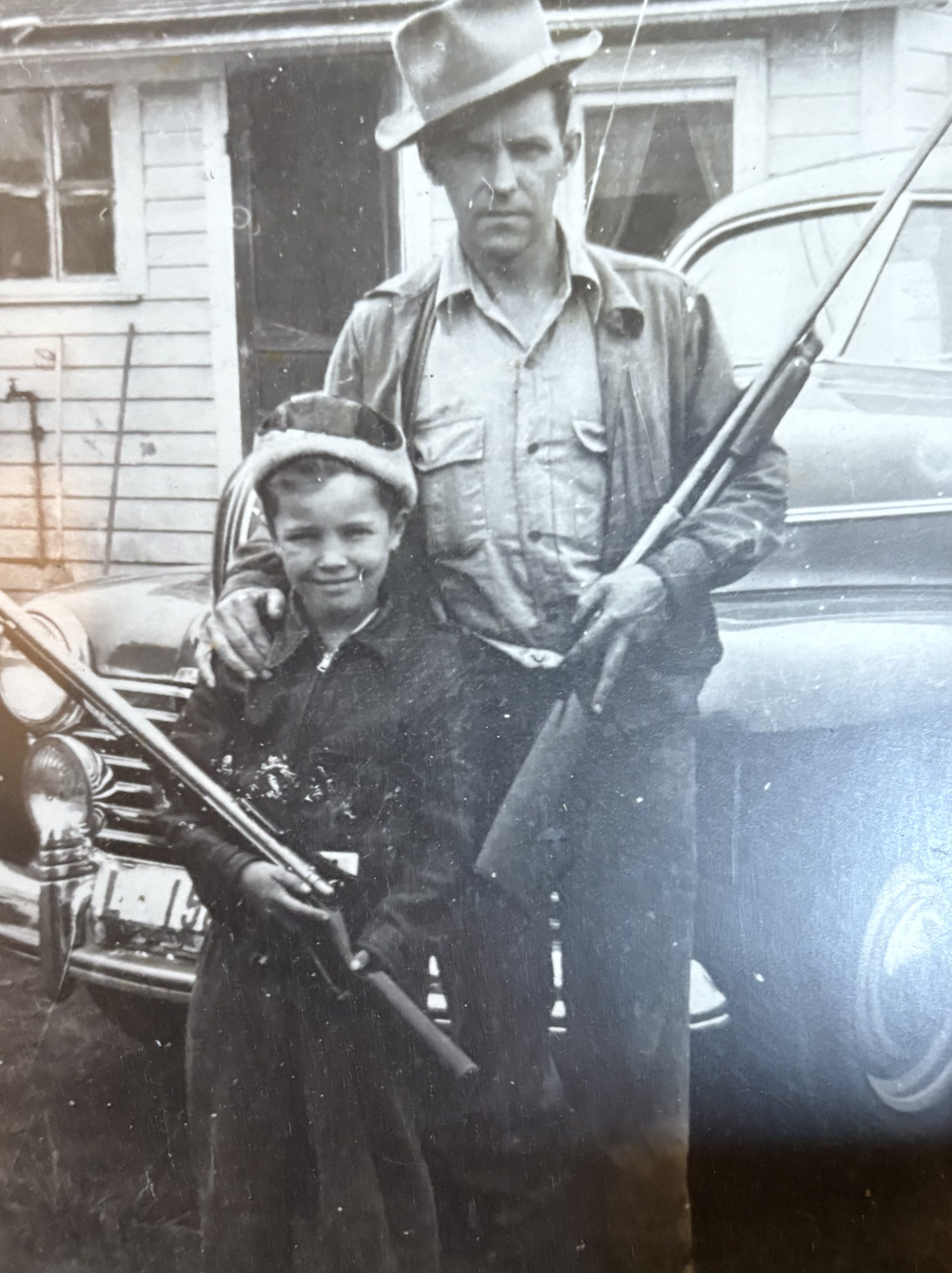
It’s apparent he has always loved the wildlife that encompassed his early life and beyond. As he grew into an adult, Jim would often sit quietly in the woods for hours on end and sketch the animals in nature, watching every move they made and how their muscles reacted. Wildlife became his passion, and Jim used it as a tool to mold his artistic calling into his life’s work as an artist and wildlife sculptor.
Jim loved high school, mostly because it was fun. He was so popular that his classmates voted him ASB president even though he didn’t even run for office. Jim was a good-looking athlete and quite the catch for the girls in his 1955 high school class of twenty-one students. Even though Jim played six-man football for three years and made all-conference his senior year, his favorite sport was always baseball. That first year after high school, Jim was a walk-on at Centralia College for the eleven-man football team. He wasn’t a starter, but he was fast and played quite a bit. While there, Jim took some art and English classes, even being assigned a research paper. Of course, Jim wrote about his idol, Norman Rockwell. When summer rolled around, Jim was ecstatic when he was offered the chance and got to play the center field position in two semi-pro baseball games. However, strapped for money and with aspirations of attending the Burnley School of Professional Art in Seattle the next year, Jim found a job making a couple of bucks an hour at a logging company to help pay for his tuition. While at the art school in Seattle, Jim realized his passion was not as a commercial illustrator; his roots as a country boy ran deep and would never leave hold of him. Jim listened to his heart and never looked back.
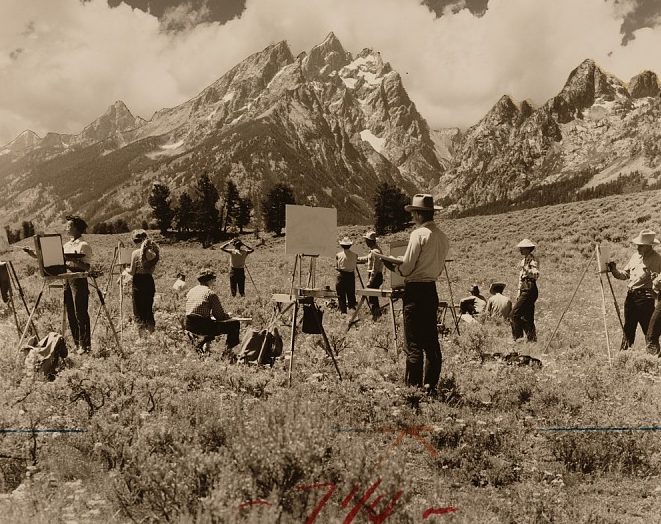
Attending art school in Seattle, Jim simultaneously took a correspondence course, “Famous Artists Course,” with Rockwell as one of the consulting artists. Rockwell cofounded the class years earlier in 1948 to help young artists learn their craft. This art class fueled Jim even more to learn from the best, and he knew where he had to go next—he just needed help getting there. Jim asked his granddad if he could borrow $300 to drive to Jackson Hole, Wyoming, to study at an outdoor summer art class that he had recently heard about. The class was nestled beautifully amongst the stunning Grand Teton Mountains and aptly named Tetons Artists Associated. That summer, Jim lived in an old log cabin for free and only had to spend money on food. The local bears, however, were eager to sabotage his makeshift refrigerator and raid its food stash at every opportunity. Jim learned from some of Rockwell’s acquaintances, also distinguished artists, and was fortunate to absorb all he could that long, enthralling summer in Jackson Hole. For those few months, Jim studied under the tutelage of Paul Bransom, a famous wildlife artist and illustrator, and alongside world-renowned artists Conrad Schwiering and Grant Hagen. All three were the founding artists of the Teton Artists Associated art school in 1957. The class was marketed as a plein air (outdoor) art school focusing on painting and drawing landscapes and animals. Even after all this time and decades later, when you step into Jim’s art studio, you feel and see the significant influence these artists have had on him throughout his life and artistic career. Jim has never taken this for granted.
Jim painted three days a week and spent the other two days pitching in to help the summer guests, which allowed him to receive free instruction. Oftentimes, Jim would tie down the easels of the working artists and tourists who painted plein air style underneath the canopy of the moving clouds on windy days. Eventually, summer came to an end. With little money left in his pockets, he found a temporary job in Wyoming bucking bales of hay for a pittance of fifty cents an hour. Not long after, Jim left behind the jagged peaks of the Teton Range and drove the arduous trip home. He arrived in Chehalis, Washington, just in time with no spare tire, an empty gas tank, and twenty-five cents to his name.
Settling back home, Jim began work at a local logging camp, falling and bucking trees. He always lent a hand with other jobs, including helping the “powder monkey” with the precarious job of planting dynamite to blast away areas for new roads. When the weather cooperated and the rain lifted, Jim always felt a familiar calm, taking deep breaths of the Pacific Northwest’s pine-scented air. It comforted him to be surrounded by nature and the wildlife he loved, with the wind in the towering trees whispering the promise of change.
One morning, a fellow logger who lived in a nearby town told Jim he had seen his name in the local newspaper. “Oh my! What did I do to warrant this?” Jim asked, as his stomach tightened. “No, it was a draft notice,” the logger replied. Though Jim normally went home on weekends, the news sent him rushing back to his house. The official letter from the Selective Service System with the “Order to Report for Induction” was waiting for him on the kitchen table. The ongoing Cold War tensions between the United States and the Soviet Union created a need for more manpower in the armed forces. Jim was officially drafted.
The spirit of the signature mountains that watched over Jim that long summer knew he had borrowed their treasures, studied them, and tucked them forever in his heart. The Tetons stood tall, looking down upon the landscape as he drove away, receding into the distance as if he were a vanishing point in his own painting. The blue skies bent down and touched Jim’s face, the wind blew him a kiss, and the wildflowers swayed and waved goodbye. Safe travels, kid.
CHAPTER SEVEN
The Letter
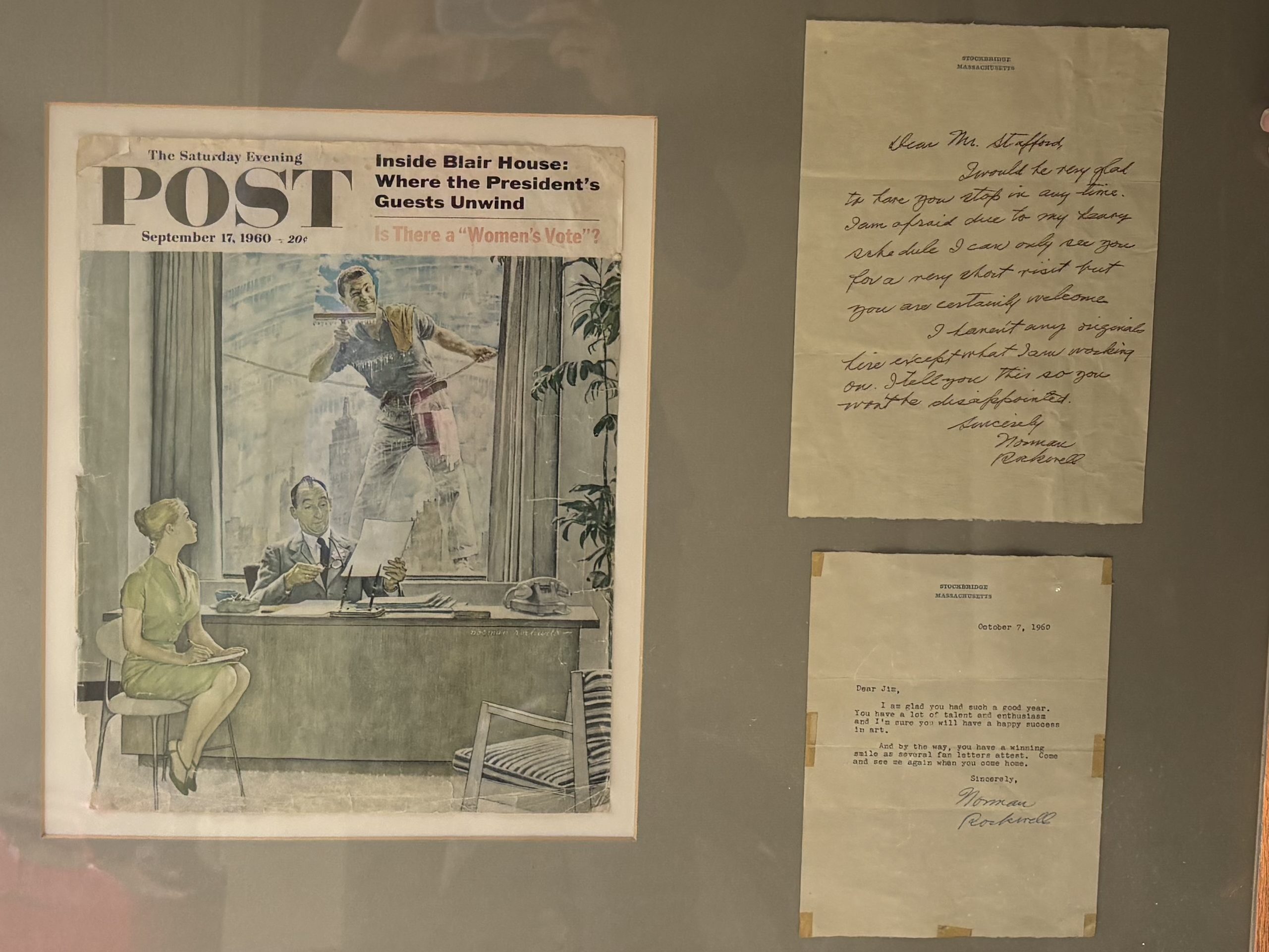
After Jim was drafted into the army in 1959, he was subsequently stationed on the opposite side of the country at Fort Devens in Massachusetts. This military requirement for a three-year stint would allow Jim to serve his country, but it also had another side benefit—it just might give him a leg up to meet his lifelong hero, Norman Rockwell. After all, being stationed on the same coast and in the same state where Rockwell lived was a heck of a lot closer than three thousand miles away back home. The trip was only a 200-mile train ride across the state. It could be the perfect opportunity for Jim to make a childhood dream come true and meet the man whose Saturday Evening Post covers were a fixture in his living room all throughout his childhood. Before any logistics were planned, Jim thought that perhaps writing Norman Rockwell a personal letter might be his best bet to ask Rockwell for a visit to his studio in Stockbridge. Jim could only imagine what it would be like to sit with Rockwell and discuss the ins and outs of being an artist, share thoughts of his own work, and hopefully glean valuable information from Rockwell in his own quest to become a known artist from Chehalis, Washington. This could be the once-in-a-lifetime chance for Jim to meet his hero and the legendary illustrator of 323 covers of The Saturday Evening Post. Besides, a lost opportunity can be lost forever if we don’t take it, right? What did he have to lose? Nothing.
Jim wrote the letter.
Hopeful, but not expected, Jim was stunned when Rockwell responded a few days later.
To Jim,
I would be very glad to have you stop in anytime. I’m afraid due to my heavy schedule, I can see you for only a very short visit but you are certainly welcome.
Sincerely,
Norman Rockwell
Jim showed the letter to the sergeant while on KP duty and asked if he and a buddy could receive furloughs to take the train to Stockbridge and meet Rockwell. The sergeant was astounded when he read the letter. After all, who didn’t know of Rockwell, especially during the wartime era? The furloughs were granted, and the two servicemen were eager to start their journey. Jim was excited to see Rockwell’s studio and must’ve had what seemed like three million questions to ask in those three days. That trip to Stockbridge ended up being more than just a short visit and evolved into much, much more. Jim thought, “Dreams DO come true!”
CHAPTER EIGHT
The Three Days of Norman and the
Unsuccessful Matchmaker
Rockwell had been busy working on the 17.5 by 6-foot 100-year commemorative mural, Pittsfield Main Street, as well as some covers for the Post. He had just taken a six-month break from his work to recover from the loss of his wife, Mary. It had been a difficult year for Rockwell, but his schedule was full again. Jim was thankful that Rockwell was willing to make time for the two privates he had invited for a visit.
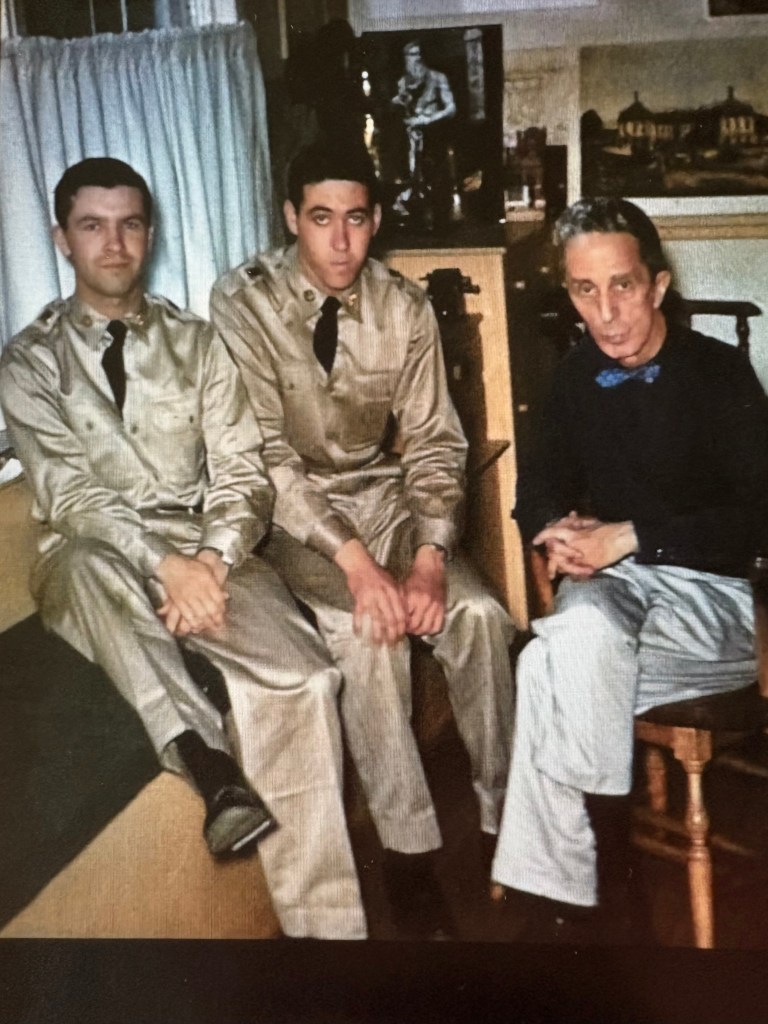
Rockwell’s handyman drove him to the train station in the artist’s old Chevy so they could meet the young military men as they stepped off the train. After they arrived back at Rockwell’s house, the first thing that Norman did was look Jim up and down and said, “You’ll do.” Jim replied, “I’ll do what?” Rockwell continued, “Well, you’ll do for a Post cover I’m working on.” Jim was stunned and responded, “Oh my,” expecting that he was there to discuss art. However, in this slice-of-life moment in his photorealism experience, Jim became the central model as the Window Washer in this flirtatious painting. He was astonished and looked like a deer caught in headlights at this new turn of events. In that moment, there was no way he could even begin to fathom how much The Wink would become legendary and recognizable everywhere and evermore. The icing on the cake was when the affable Rockwell invited Jim and his buddy to stay in the two spare bedrooms at his house for those next few days. It soon became clear that Rockwell’s hosting abilities were second to none and had exceeded any expectations for the two servicemen, especially for Jim, the budding artist. This immersive experience enriched Jim’s vision for the future.
Throughout his Three Days of Norman, Rockwell kept telling Jim he should go and meet that young gal that sat for her photo sessions a number of days earlier. Rockwell showed Jim a photograph of her and told him, “Boy oh boy, she sure was a real looker—you really ought to go meet that cutie.” It was clear that when Jim took a look at the photo, he was enamored by her charm and beauty. Jim replied, “Norman, I’m just a private in the army, and I don’t have enough money for gas or enough to offer that young gal.” It was obvious to Rockwell there was a spark and a hopeful connection for Jim, just like in the Saturday Evening Post cover that Norman was currently working on. Rockwell suggested to Jim that he could use his other car, not the old Chevy, to go and meet that cute girl. The car being offered up was a long Ford Lincoln Continental that the Ford Motor Company had given to Rockwell in return for all of the PR and advertising he had done for the company. Rockwell never liked that car, as it was way too long to even fit in his garage, and he seldom used it.
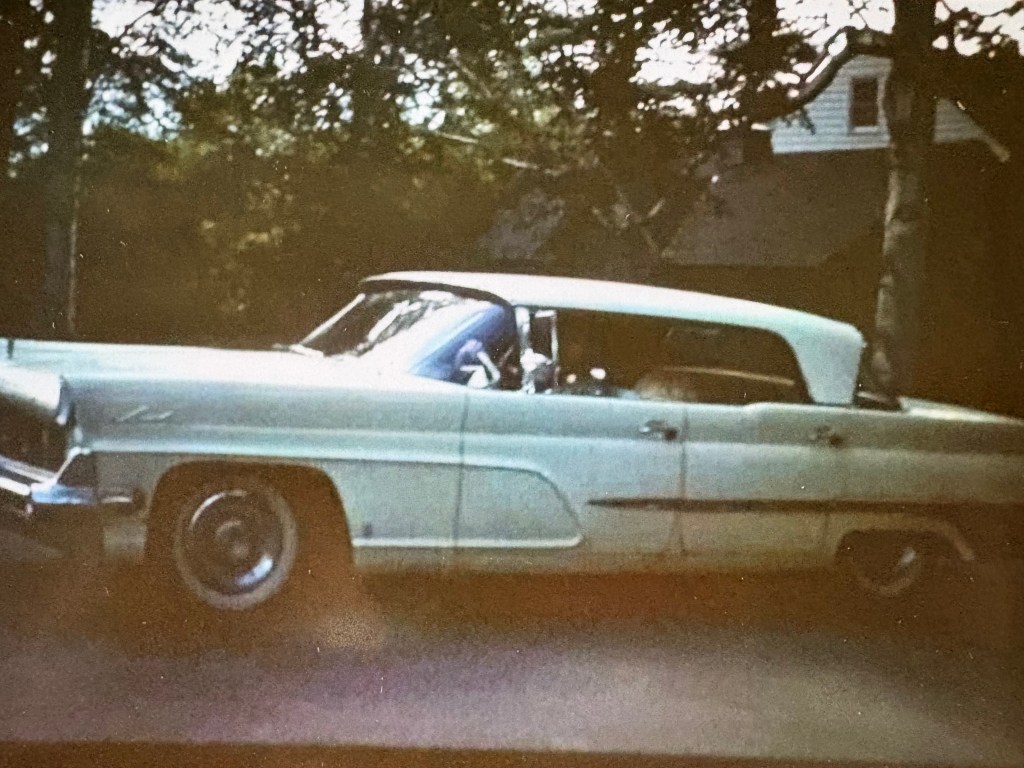
Nevertheless, Jim thought about pursuing that elusive young lady in the photo, but it just seemed insurmountable to him. Now he regrets that! Although Rockwell certainly had great success during his long career as an iconic and prolific artist, one thing that’s for sure: Norman was definitely an unsuccessful matchmaker—though, it wasn’t for lack of trying.
Jim’s photo session with Rockwell included a lot of standing on a ladder outside Rockwell’s studio window while pretending to hold a squeegee, the tool of the trade for a real window washer. Rockwell focused on the infamous wink—Jim must’ve contorted his face what felt like a hundred times until The Wink satisfied Rockwell’s perfectionism for the portrayed situation. Always the director of his paintings, Rockwell would hone in on every aspect and nuance of what he, himself, expected. The final product for the Post cover was perfect, and, even though millions of us have seen the painting, we each have our own individual interpretation of its visual effect.
In between the hours at the studio, the two young military men in their early twenties got thrashed in badminton matches in Rockwell’s back yard. They probably weren’t the only ones who ever got tricked into playing a match with the spirited host in his sixties who gleefully beat each opponent who challenged him. The three men often sat around gabbing, eating, and discussing art. At one point, Rockwell invited Jim to sketch his buddy and then critiqued the fresh art with Jim by his side—it was beyond what Jim could’ve imagined! Rockwell was an incredibly down-to-earth fellow, so it wasn’t surprising that his congenial nature made Jim, and his buddy, feel welcomed into his home. On the flip side, the privates from Fort Devens may have been exactly what Norman needed as well.
The previous year had been too overwhelming for Rockwell to finish the Pittsfield Main Street mural, and he knew it would be best to pass the task on to another artist. Jim watched as a large semi-truck arrived, loaded up the unfinished mural, and drove it away to another artist to finish. With renewed energy, Rockwell was able to focus more on his usual projects that weren’t as time-consuming as the mural. Norman could now turn his attention to other things.
One night during their visit, Rockwell had a few different socials to attend at church gatherings. It seemed as if every widow or single elderly women was there to talk, smile, and fawn over the recent widower. Rockwell told Jim and his buddy, “Make yourselves at home, have some tea, and I’ll be back in a few hours.” Later that night when Rockwell came back to his house, he told the two servicemen, “I’m heading back to the parish hall—I’ll see ya in a few hours.” He returned the next morning. Mourning was over.
When Jim and his buddy were about to get on the train to head back to Fort Devens, Rockwell thanked Jim and told him, “Here—I have some money for you.” Jim looked at the check Rockwell was holding in his hand. He replied, “I’m not taking any money—this was an honor!” With a mischievous glint in his eye, Rockwell said, “You wouldn’t turn down $3,000, would you?” At first, speechless, Jim had to take a look, so he grabbed the check from Rockwell. He first looked at the check and then back at Norman. Jim noticed the check was only written for $30. “Norman, I think you forgot a few zeros here?” They all had a big laugh, as Rockwell knew it was human nature that Jim wouldn’t be able to resist looking at that check. To this day, Jim remembers his hero as a kind, observant, and caring man with a twinkle in his eye as he teased the promising young artist. In the end, Jim was happy to take the $30 check from Rockwell in exchange for the priceless Three Days of Norman. It still hadn’t quite sunk in for Jim, that soon, millions of people would be inviting him and “that cute gal” into their living rooms when their September 17, 1960, issues of The Saturday Evening Post would arrive with the charming couple on the cover. A month later, Rockwell wrote Jim again and invited him for another visit. Since Jim’s sister was getting married, he was unable to visit him and had to decline the invitation. Darn it.
Dear Jim, October 7, 1960
I am glad you had such a good year. You have a lot of talent and enthusiasm and I’m sure you will have a happy success in art.
And by the way, you have a winning smile as several fan letters attest. Come and see me again when you come home.
Sincerely,
Norman Rockwell
CHAPTER NINE
Life After Norman
As you may have realized by now, one of the last pieces of this puzzle has been woven throughout the story—Rockwell’s models for the characters in his paintings were not always assembled together at the same time for their individual photographs. This is why the Window Washer and the Secretary never, ever met.
The lives of Nan and Jim diverged after that special time they each spent with Rockwell. Over the years, they ended up living in adjoining states with lives that paralleled but never intersected. Nan eventually moved to the West Coast, settling in Oregon with her husband until she was widowed in 2023. Meanwhile, after his experience with Rockwell, Jim fulfilled his military commitment by serving two more years in Germany. While stationed in West Berlin, he specialized in intercepting Russian messages using fire-control radar, the latest technology at the time, sharing the intelligence with the Americans.
Though they had both gained a lifetime of wisdom, the timing never allowed a serendipitous moment for Nan and Jim to bond over their moments with Rockwell. At least now, both Nan and Jim are on the West Coast, so who knows what could happen. Remember, in any good story, there are twists and turns along the way.
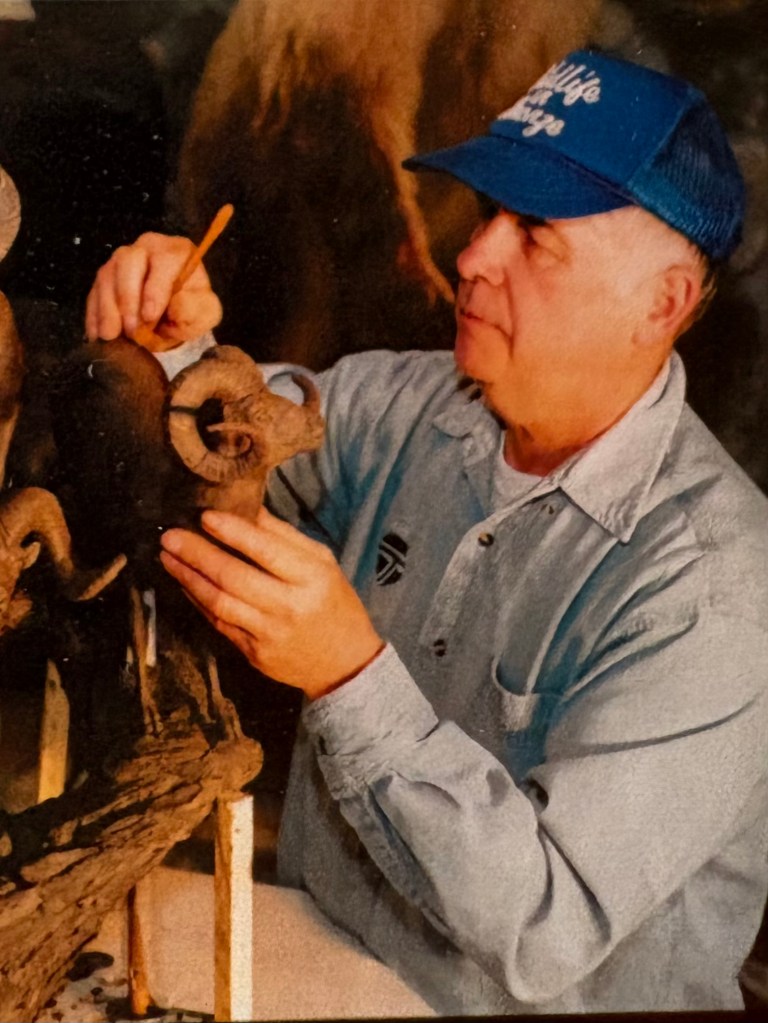
Jim, like Nan, married and pursued higher education to achieve his goals. His wife, Donna, a teacher, was instrumental in supporting Jim during his college endeavors while they raised their family. For the final leg of his educational journey, Jim was able to use the GI Bill in 1968 and attended the University of Oregon, earning a Master of Fine Arts (MFA). Since then, he became an art teacher at Centralia College and later taught for six years at Wenatchee Valley College, building two foundries while there. Jim’s daughter, also an educator, teaches a unit on Norman Rockwell each year in her art class. The thread between Rockwell and both Nan and Jim continues to weave its story through her art instruction. The class is delighted and impressed that her father is the Window Washer from the Norman Rockwell cover from the September 17, 1960, Saturday Evening Post cover that millions have seen. Of course, she always expounds and celebrates her father’s talents and contributions to the art world, along with his many awards and accolades. However, to this day, Jim will always say his best work of art is his children.
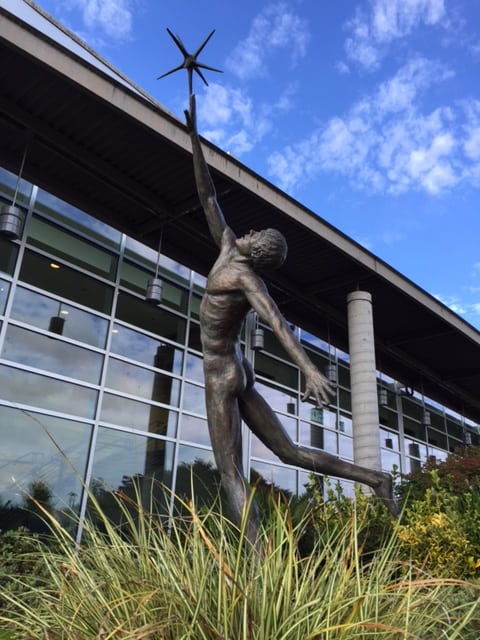
Jim and his wife had three children, including a boy and girl who were twins. For most people, little ones can be a handful, but after twenty-five years of marriage, tragedy struck their lives with the passing of his wife due to breast cancer. Suddenly, Jim was left to raise three teenagers, alone. A few years later, heartbreak once more hit home. His son, Christopher, the twin boy, always had difficulty with balance and coordination throughout his childhood, but the symptoms progressed. Christopher was eventually diagnosed with a rare genetic and progressive neurogenic disease, Friedreich’s Ataxia, Though Christopher was in a wheelchair during his senior year at Adna High School, he graduated as salutatorian in 1991. The insidious disease took Christopher’s life in February of 1995 at the young age of twenty-two. A bronze statue of a young man reaching toward a star that is just out of reach, titled Reach for the Stars, is displayed on the campus of Centralia College. The sculpture, a life-size bronze of Christopher, was commissioned by the school in 2001. Jim created this beautiful sculpture in honor of his son.
CHAPTER TEN
Voices Connect
Meeting Nan and finding Jim a week later only left a few things for me to tidy up. Being the non-techy person that I am, I scrambled around to find that one gadget to attach to the other gadget to my iPhone to record the first conversation between the Window Washer and the Secretary. Neither of them had access to a visual connection, so we all did our best with an iPhone and a tripod—that was hard enough for me! The anticipation was great as Nan dialed the phone—and the conversation began.
Jim chuckles and says, “Hi there, Nan . . . I can’t believe this is happening—it’s been sixty-five years.”
Nan giggles back and says, “We are very, very, very old friends, emphasis on old!”
Jim replies, “I bet you’re as cute as you were in the picture. I’ll just bet, though.”
Nan laughs and says, “Well that picture has changed a little bit.”
The conversation lasted for twenty-eight minutes, and a life’s worth of memories and journeys were shared. My husband and I melted into the background as we watched something magical happen right in front of us. Tears welled up as we looked at one another. I am glad I was the twist in this fairy tale.
CHAPTER ELEVEN
The Ornaments
As Christmas approached, I ordered metal ornaments for Nan and Jim to hang in their homes for the holiday season. The ornaments included five photos from different eras plus a photo of the Window Washer painting. I made sure these special gifts would arrive in plenty of time so I could expeditiously get them to my new friends that lived in separate states. Thanks, Shutterfly! First, I walked Nan’s ornament over to her house. The neighborhood was lit up and brimming with Christmas lights of all colors, but when Nan opened her front door, her unparalleled smile outshined any of them. She loved her new gift. Next, I sent Jim’s ornament via snail mail and was able to track its path. Thanks, USPS! It seemed that all the little boys and girls were tracking Santa’s sleigh and had the same idea.
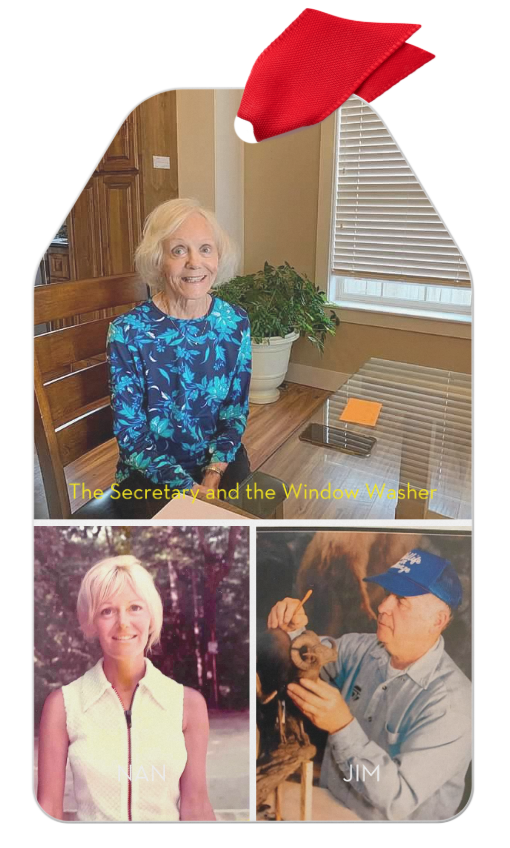
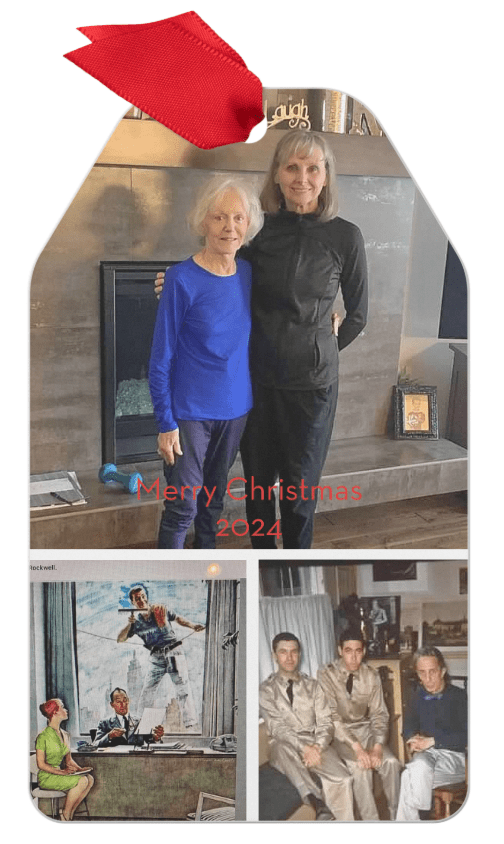
When I realized the package had arrived at Jim’s house, I exclaimed, “Yeeesss, it’s there!” I called Jim and he answered the phone right away. He was sitting in his favorite cozy chair in the living room, and I could tell he was admiring the ornament like a cherished memory. It was revealing when he sighed sentimentally. “You know,” he said, pausing, “I look at the Window Washer picture every day, and now it’s even more special to me.” Jim was wonderstruck with this new treasure, flipping it from front to back and back to front while holding it in the well-worn hands of a dedicated artist and bronze wildlife sculptor. The eighty-eight-year-old man was both flabbergasted and nostalgic at the same time. Rhetorically, he asked, “How did all those photos fit on that one ornament?” He was amazed at how I even added the photo his daughter had sent to me of Rockwell, Jim, and his buddy sitting around and relaxing. Jim was movie star handsome, that’s for sure! His voice lit up and he continued, “I haven’t seen that photo of me and Rockwell in a looong time!”
Although Jim liked all the photos, he was particularly drawn to those of Nan, the Secretary. Years and years have gone by, and Jim never would’ve thought he’d ever get the chance to meet “that cute girl” in person. Jim quietly reflected and said, “It’s all so very magical to even think of.” He then added, “I told my daughter the other day, THAT could’ve been your mother.” His daughter smiled and replied, “I am glad she wasn’t—as it is, things turned out just fine.”
CHAPTER TWELVE
The Possibility
The prints of The Window Washer that hang in both Jim’s and Nan’s houses have much more meaning to them since that legendary dog walk. The lives they’ve lived, their generosity toward others, and an abundance of life experiences are more than that singular moment in time with the innocent wink and a glance of hope. Nan and Jim are no longer strangers, but even if they don’t ever meet in person, they will always carry each other in their hearts as new friends with a common thread. Alongside the print of The Window Washer that proudly hangs in Jim’s house are the two framed letters that Rockwell wrote to him what seems like another lifetime ago. Funny, come to think of it, whenever Jim and Nan pass by and glance at The Window Washer hanging on their walls, they too, are the observers of their own youthful selves in that fictional moment sixty-five years ago. They are reminded that the magical storybook fairy-tale truly exists, not just within the lad and the maiden, but also the millions of us that have been a part of their journey.
The hopeful possibility that Jim and his family will come to our neighborhood this summer is on the drawing board. With great expectations, it is heartening to think that Jim and Nan might get the chance to see each other and Jim can finally give her The Wink in person. At least now when Jim’s daughter teaches her art class with the unit on Norman Rockwell, she can finally put a name, Nan, to the young woman in the green dress who looks up at her father to catch his glance. Even though she was never a secretary, and he was never a window washer, I am certain that Nan and Jim don’t mind if you see them as the no longer mysterious lad and maiden in the poem. Besides, you have now discovered the brilliant people they are, who followed their dreams and made a difference in this world.
CHAPTER THIRTEEN
The Question and the Final Piece of the Puzzle
Time seems to be chasing all of us and the days trip over one another as the seasons blur into years. Nan and Jim, both young at heart, often reflect on their lives. They smile with the hope that a few more enchanted moments might be added to this very special story that resurfaced from their youth. Sometimes it feels like yesterday and long ago, but today, it truly gives them great joy.
Throughout this journey of connecting the Window Washer and the Secretary, I realized I have gained two new friends who have also given me tremendous joy and lots of shared laughter along the way. Nan lives just around the corner from me, and we see each other at least once a week. I always call her before I head over to her house—when I get there, I ring the doorbell and give our special secret knock so she will know it’s me. Each time I talk to Jim on the phone, and before we hang up, he always tells me, “Next time you see Nan, give her a hug and a wink for me.” I always do.
Let’s all celebrate the lives Nan and Jim have lived and the brushstrokes that have jumped from the canvas and into all of our lives from that magical moment sixty-five years ago. In the meantime, even though we have all smiled and hoped that maybe, just maybe, the 500th piece of the puzzle will nestle perfectly home, there is one more question that would help complete the puzzle. Nan and Jim have expressed interest in finding out what caught the eye of the person who truly loves this flirty and romantic painting, The Window Washer, enough to own the original that hangs above their fireplace?
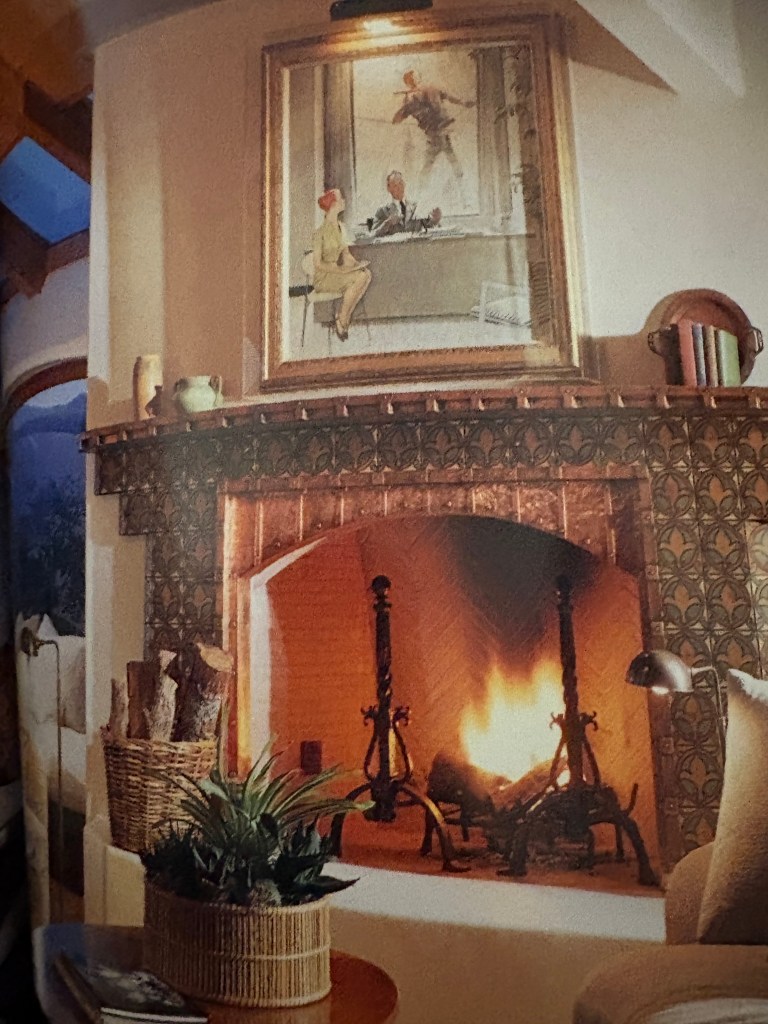
This question is a mystery that only one person knows the answer to, which can propel this magical storybook fairy-tale to its happily-ever-after-ending—Mr. Steven Spielberg.
 Waterfall Starts